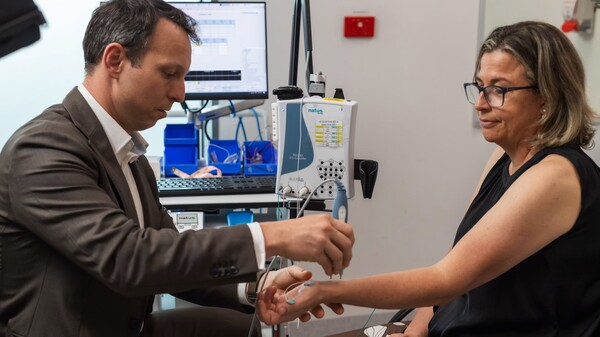
NuNerve is taking its lead motor neurone disease therapy into a national Phase 2 trial after early signs of disease stabilisation and functional improvement in its first human study.
The Queensland clinical-stage CNS biotech will recruit 75 participants to test NUN-004, a long-acting protein-based therapy that inhibits EphA4, a receptor whose excessive signalling has been linked to motor neuron degeneration and impaired nerve repair.
NuNerve chair Emeritus Professor Perry Bartlett AO said the therapy aimed to do more than slow decline.
"No approved treatment has been shown to halt or reverse progression across the broad MND population,” he said.
“NUN-004 was designed to go further to protect motor neurons and create the conditions for damaged neural connections to repair."
Participants will be randomised 2:1 to NUN-004 or placebo for 24 weeks of double-blind treatment, followed by a 24-week open-label extension in which all receive the therapy. The study will assess change in the ALS Functional Rating Scale-Revised, safety and tolerability, and respiratory, neurophysiological, quality-of-life, and biomarker measures at sites on the Sunshine Coast and in Sydney, Newcastle, Brisbane and Perth.
Clinical lead Associate Professor Antony Winkel said the trial would "determine whether the early Phase I signal is a real treatment effect."
The Phase I/Ib study of 20 healthy volunteers and eight people with MND found NUN-004 was well tolerated, with disease stabilising during treatment and participants reporting better grip, balance, walking and strength and less fatigue.
NuNerve was established by the Estate Peter Goodenough Unit Trust and UniQuest to build on more than 25 years of research by Professor Bartlett and Emeritus Professor Andrew Boyd at the University of Queensland's Queensland Brain Institute. The program has received three consecutive FightMND grants.
The company said it will seek international investment and partners to take NUN-004 into Phase 3 and towards regulatory approval in major markets.